
The Different Types of Mulligans in MTG, Explained

Magic: The Gathering has used four major mulligan rules in its history: the original "no lands or all lands" rule, the Paris mulligan (1997), the Vancouver mulligan (2015), and the London mulligan (2019), which is the rule used today. Each change made bad opening hands less punishing.
Here's how every version worked, why it changed, and where variants like Commander's free mulligan fit in.
The Original Mulligan Rule: All or Nothing
In Magic's earliest years, you couldn't mulligan just because your hand was bad. You could only take a mulligan if your opening hand contained zero lands or all lands — and you had to reveal it to prove it. You then shuffled and drew a fresh seven at no penalty.
The problem was obvious: a one-land hand full of expensive spells was unkeepable but also un-mulliganable. Games were regularly decided before turn one, which is exactly what mulligan rules exist to prevent.
The Paris Mulligan (1997): One Card Fewer
Introduced at Pro Tour Paris in 1997, the Paris mulligan let you mulligan any hand, for any reason — at the cost of one card each time. Shuffle your seven back, draw six. Not good enough? Draw five. And so on.
This was a huge improvement and lasted nearly two decades. Its weakness was the compounding penalty: a six-card hand often wasn't much better than the seven you shipped, and a five-card hand rarely won at all. Mulliganing felt like choosing how you wanted to lose.
The Vancouver Mulligan (2015): The Scry Patch
Tested at Pro Tour Magic Origins in Vancouver and adopted alongside Battle for Zendikar in 2015, the Vancouver mulligan kept the Paris structure and added one fix: after keeping a hand of fewer than seven cards, you could scry 1 — look at the top card of your library and leave it or put it on the bottom.
Scrying is a small consolation, but it mattered: a six-card hand that could dodge a dead draw was meaningfully more competitive. Still, the core problem remained — mulligans took away raw cards, and card disadvantage decided games.
The London Mulligan (2019): Always See Seven
The current rule debuted as a trial at Mythic Championship II in London in early 2019 and became official with Core Set 2020 that summer. Under the London mulligan, every mulligan works the same way:
- Shuffle your hand into your library.
- Draw a fresh seven cards.
- Put one card from your hand on the bottom of your library for each mulligan you've taken.
You always see seven cards and choose the best six (or five) yourself, instead of being dealt a random smaller hand. That selection makes mulligans dramatically less punishing — and slightly more powerful for decks hunting a specific card, which is why the rule was controversial in formats like Modern before it stuck.
Knowing what to bottom is now a real skill. We cover it in When Should You Mulligan in MTG?
The Free Mulligan in Commander
Commander adds one more layer. In casual multiplayer games, a player's first mulligan is free — you draw a new seven and bottom nothing. Only from your second mulligan onward do you start bottoming cards.
Commander veterans may also remember the partial Paris mulligan, a format-specific rule used before 2015: instead of shuffling your whole hand back, you exiled only the cards you didn't want and drew that many minus one. It rewarded keeping the good half of a hand, but it was slow and confusing at the table, and the format moved to the standard rule with a free first mulligan instead.
Card-Based "Mulligans": Serum Powder and Friends
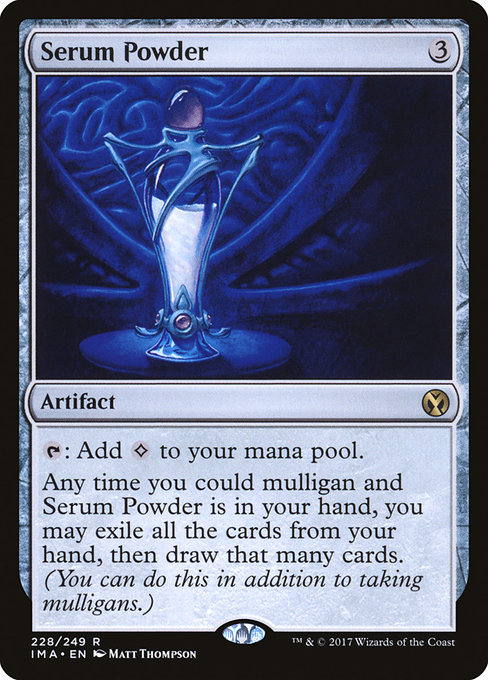
A few cards interact with the mulligan process itself. The most famous is Serum Powder — while it's in your opening hand, you may exile that entire hand and draw that many cards, effectively a free extra mulligan. It's a staple of dedicated combo strategies that need one specific card in their opener.
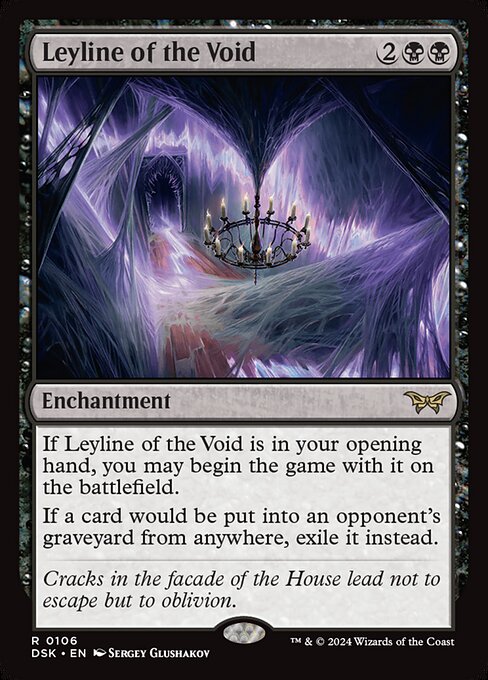
Opening hands also matter to cards you never cast. The Leyline cycle, like Leyline of the Void, starts on the battlefield for free if it's in your opening hand — one more reason the "always see seven" London rule changed deckbuilding math.
Every MTG Mulligan Rule at a Glance
- Original rule (1993): redraw seven only if your hand had no lands or all lands.
- Paris mulligan (1997): mulligan any hand; draw one fewer card each time.
- Vancouver mulligan (2015): Paris, plus scry 1 after keeping fewer than seven.
- London mulligan (2019–today): always draw seven, then bottom one card per mulligan taken.
- Commander free mulligan: in casual multiplayer, your first mulligan costs nothing.
Every revision moved the same direction: fewer non-games, more real Magic. So the next time you draw a rough seven, remember: you're playing under the most forgiving mulligan rule the game has had so far— use it.



Comments
Join the conversation.